gcsescience.com 60 gcsescience.com
What is the Structure of the Earth?
The
waves
from earthquakes that travel through the
Earth
give information about the structure of the inside
of the planet.
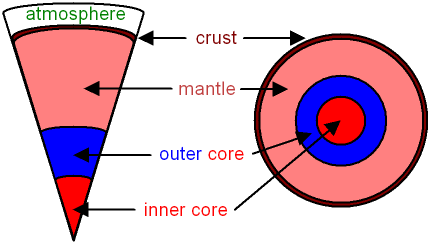
A picture of the structure of the Earth
is shown below.
The outer crust (called the lithosphere) is made from solid rock.
The mantle is made from hot
solid rock
which can
flow only very
very slowly.
The mantle behaves more like a
solid than a liquid.
The mantle goes down nearly half way to the Earth's centre.
The density of the
rocks which are found in the
Earth's
crust is lower than the density of the planet
as a whole.
This means that the core of the
Earth must be made
from
a
material that is more dense than rock. It is
believed that the core is made
from a mixture of iron
and nickel. The outer core is liquid, the
inner core is solid.
Waves that travel through the Earth
change direction
as they meet the different layers (see the next
page).
 Links
Waves
Plate Tectonics
Revision Questions
Links
Waves
Plate Tectonics
Revision Questions
gcsescience.com Physics Quiz Index Earthquake Quiz gcsescience.com
Home GCSE Chemistry GCSE Physics
Copyright © 2015 gcsescience.com. All Rights Reserved.